
IEEE Format For Research Paper: Complete Guide with Structure & Examples
The IEEE Format For Research Paper is one of the most widely used academic formats in engineering, computer science, electronics, and technology-related fields. This format is defined by the Institute of Electrical and Electronics Engineers to maintain consistency, clarity, and professionalism across research publications. Understanding and correctly applying the IEEE format is essential for researchers aiming to publish their work in reputable journals or conferences.
This article provides a detailed explanation of the IEEE Format For Research Paper, including structure, formatting rules, section-wise guidance, and common mistakes to avoid.
What Is IEEE Format For Research Paper?
The IEEE Format For Research Paper is a standardized layout and writing style used for academic and technical research papers. It focuses on precise formatting, structured sections, and a numbered citation system that improves readability and reference tracking.
This format is especially popular in technical disciplines because it presents complex data in a clear, concise, and professional manner. IEEE formatting ensures that all published research follows the same structure, making it easier for readers to compare, analyze, and understand different studies.
Importance of IEEE Format For Research Paper
Using the IEEE Format For Research Paper is important for several reasons:
-
It ensures uniform presentation across all academic papers
-
It improves the professional appearance of research work
-
It enhances clarity and logical flow of information
-
It increases acceptance chances in IEEE-recognized journals and conferences
-
It supports accurate and compact referencing
Researchers who follow IEEE guidelines demonstrate academic discipline and attention to detail, which are critical factors in scholarly publishing.
General Structure of IEEE Format For Research Paper
A standard IEEE Format For Research Paper follows a specific structure. Each section plays a key role in presenting the research effectively.
Title
The title should be concise, informative, and relevant to the research topic. It must clearly reflect the core idea of the study without being overly long. Titles are written in title case and centered at the top of the first page.
Author Information
Below the title, author names are listed along with their affiliations. This includes department name, institution name, city, country, and email address. Proper author identification adds credibility to the research paper.
Abstract
The abstract is a brief summary of the entire paper and is a critical component of the IEEE Format For Research Paper. It usually ranges between 150 and 250 words.
The abstract should include:
-
The research problem
-
Objectives of the study
-
Methodology used
-
Key findings
-
Overall significance
It must be written in a single paragraph and should not contain citations, figures, or equations.
Keywords
Keywords are placed immediately after the abstract. Typically, three to five keywords are used. These terms help categorize the research paper and improve discoverability in academic databases.
Introduction Section
The introduction sets the foundation of the research paper. In the IEEE Format For Research Paper, the introduction should:
-
Provide background information
-
Explain the research problem
-
Highlight the significance of the study
-
State research objectives or hypotheses
-
Briefly discuss related work
A strong introduction helps readers understand why the research is important and what gap it aims to fill.
Literature Review or Related Work
This section discusses existing research related to the topic. It demonstrates the author’s understanding of prior studies and highlights how the current research differs or improves upon previous work.
In the IEEE Format For Research Paper, citations are numbered sequentially and referenced within square brackets. This keeps the text clean and easy to read.
Methodology Section
The methodology section explains how the research was conducted. It is one of the most technical parts of the paper and should be written clearly and precisely.
This section may include:
-
Research design
-
Tools and software used
-
Experimental setup
-
Data collection methods
-
Algorithms or models applied
In IEEE formatting, clarity and reproducibility are essential. Another researcher should be able to replicate the study using the information provided.
Results Section
The results section presents the findings of the research without interpretation. Data should be displayed using tables, figures, and graphs where necessary.
In the IEEE Format For Research Paper, all tables and figures must be numbered and labeled properly. The results should be factual, concise, and well-organized.
Discussion Section
The discussion interprets the results and explains their significance. This section connects findings with research objectives and existing literature.
Authors should:
-
Explain trends and patterns
-
Compare results with previous studies
-
Discuss limitations
-
Highlight practical or theoretical implications
The discussion section strengthens the overall contribution of the research paper.
Conclusion
The conclusion summarizes the entire study and reinforces the key findings. In the IEEE Format For Research Paper, the conclusion should not introduce new data.
It typically includes:
-
Summary of main results
-
Importance of the research
-
Practical applications
-
Suggestions for future work
A clear conclusion leaves a strong final impression on readers.
Acknowledgment Section
This optional section is used to thank individuals, institutions, or organizations that supported the research but did not qualify for authorship. Funding sources are also mentioned here.
References in IEEE Format For Research Paper
Referencing is a defining feature of the IEEE Format For Research Paper. References are listed at the end of the document in the order they appear in the text.
Key characteristics include:
-
Numbered reference list
-
Square brackets for in-text citations
-
Consistent formatting for books, journals, and conference papers
This system saves space and keeps technical writing concise.
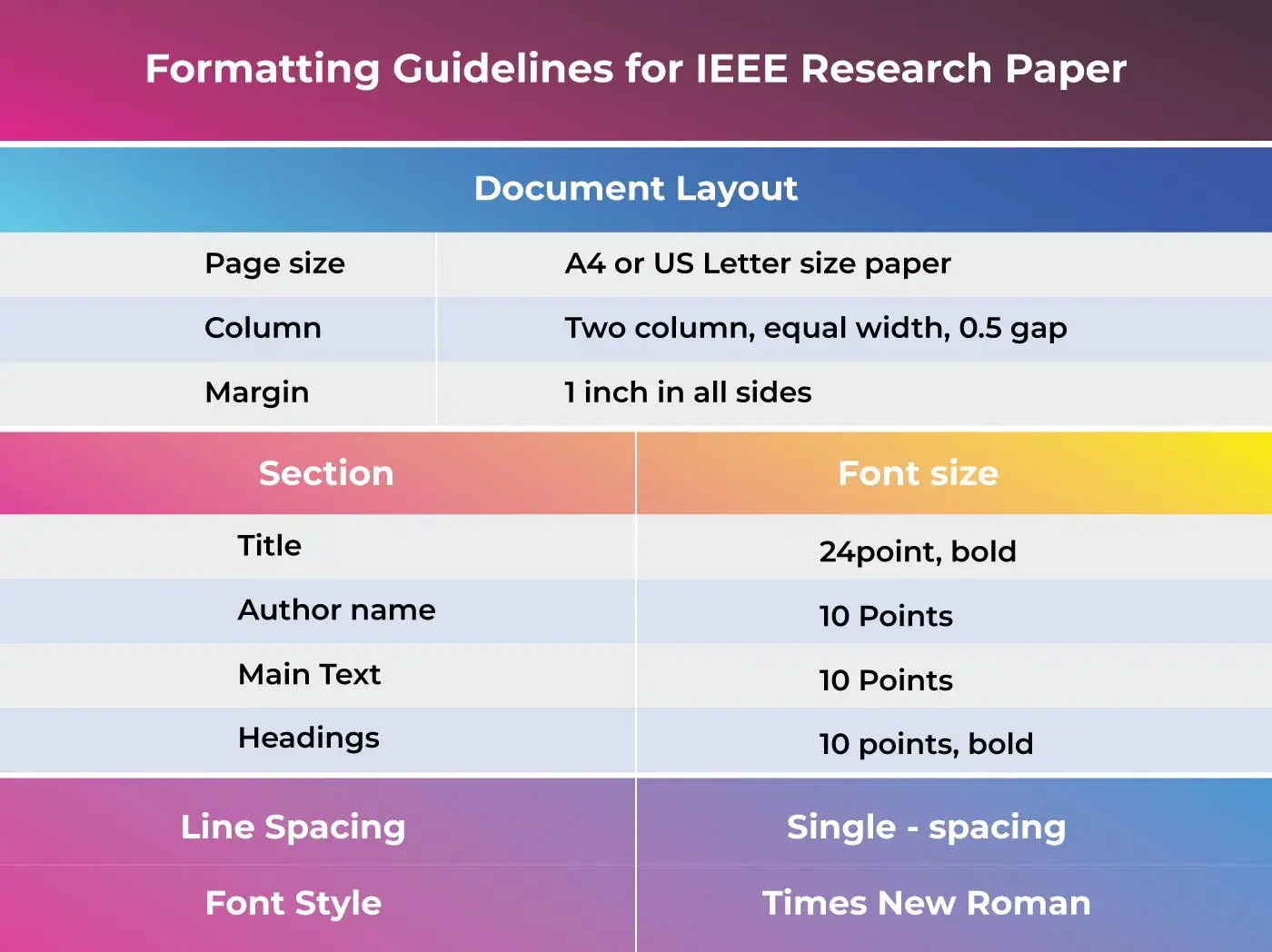
Formatting Guidelines for IEEE Research Papers
To meet IEEE standards, specific formatting rules must be followed.
Page Layout
-
Two-column format
-
Standard margins on all sides
-
Single-spaced text
-
No page numbers
Font and Text Style
-
Times New Roman font
-
10-point font size for body text
-
Bold font for section headings
-
Italics for subheadings where required
Consistency in font and spacing is essential in the IEEE Format For Research Paper.
Headings and Subheadings
IEEE uses a hierarchical heading system:
-
Main headings in uppercase and centered
-
Subheadings aligned to the left
-
Proper numbering where applicable
Correct heading structure improves readability and organization.
Figures, Tables, and Equations
-
Figures are labeled below the image
-
Tables are labeled above
-
Equations are numbered consecutively
-
All visuals must be referenced in the text
These elements should support the research, not distract from it.
Common Mistakes to Avoid
Many researchers fail to follow IEEE guidelines correctly. Common mistakes include:
-
Incorrect citation numbering
-
Improper heading formats
-
Excessive keyword repetition
-
Missing abstract keywords
-
Poor figure or table labeling
Avoiding these errors ensures compliance with the IEEE Format For Research Paper.
Tips for Writing an Effective IEEE Research Paper
-
Use a clear and logical outline before writing
-
Follow IEEE templates for accuracy
-
Maintain formal and objective language
-
Proofread for grammar and formatting errors
-
Keep keyword usage natural and limited
Attention to detail significantly improves paper quality and acceptance chances.
Final Thoughts
The IEEE Format For Research Paper is a globally accepted standard that ensures clarity, professionalism, and consistency in academic writing. By understanding its structure, formatting rules, and citation style, researchers can present their work more effectively and increase their chances of successful publication.
Following IEEE guidelines is not just about formatting—it reflects the quality, credibility, and seriousness of your research. Mastering this format is an essential skill for every academic and technical writer.